
For over two decades, digital marketers and business owners have chased the same elusive goal: ranking on Google’s first page. We’ve been told it’s the holy grail of online visibility, the make-or-break factor for business success, the digital promised land. But in 2025, with AI-powered search, voice assistants, and changing user behaviors, is Google first page ranking still the ultimate prize it once was?
This comprehensive analysis cuts through the hype to give you a data-driven perspective on what first page Google results actually mean for your business today. We’ll explore the hard numbers, examine the shifting landscape of search behavior, and provide actionable strategies whether you’re fighting for position #1 or building visibility from page two and beyond.
- The Cold Hard Numbers: First Page Click-Through Rates in 2025
- The User Behavior Shift: How We Search in 2025
- The Competitive Landscape: Who Actually Ranks on Page One
- Beyond Page One: The Hidden Value of Lower Rankings
- First Page Strategies That Actually Work in 2025
- Measuring What Matters: Beyond First Page Obsession
- FAQs: Google First Page Importance
The Cold Hard Numbers: First Page Click-Through Rates in 2025
Let’s start with what we know for certain about Google search results page one performance. The data reveals a story of extreme concentration of traffic and attention.

The spotlight effect: How attention concentrates on the top Google search results
According to recent studies from Backlinko’s analysis of over 4 million search results, the distribution of clicks follows a predictable but brutal pattern:
| Position | Average CTR | Traffic Share | Revenue Impact |
|---|---|---|---|
| Position #1 | 28.5% | 31.2% of first page traffic | High – Direct conversions |
| Position #2 | 15.7% | 17.2% of first page traffic | High – Quality leads |
| Position #3 | 11.4% | 12.5% of first page traffic | Medium-High – Strong consideration |
| Positions #4-5 | 7.2% | 15.8% of first page traffic | Medium – Research phase |
| Positions #6-10 | 3.8% | 23.3% of first page traffic | Low-Medium – Early discovery |
| Page 2+ | 1.2% | 7.3% of all search traffic | Low – Brand discovery only |
The Harsh Reality: Moving from position #2 to #1 can double your click-through rate, while dropping from #3 to #4 can cut it by nearly 40%. The difference between ranking on page one versus page two isn’t just significant—it’s often the difference between business viability and digital obscurity.
The User Behavior Shift: How We Search in 2025
The traditional Google search results page has evolved dramatically, and so has how users interact with it. Understanding these behavioral shifts is crucial for contextualizing the importance of first page rankings.
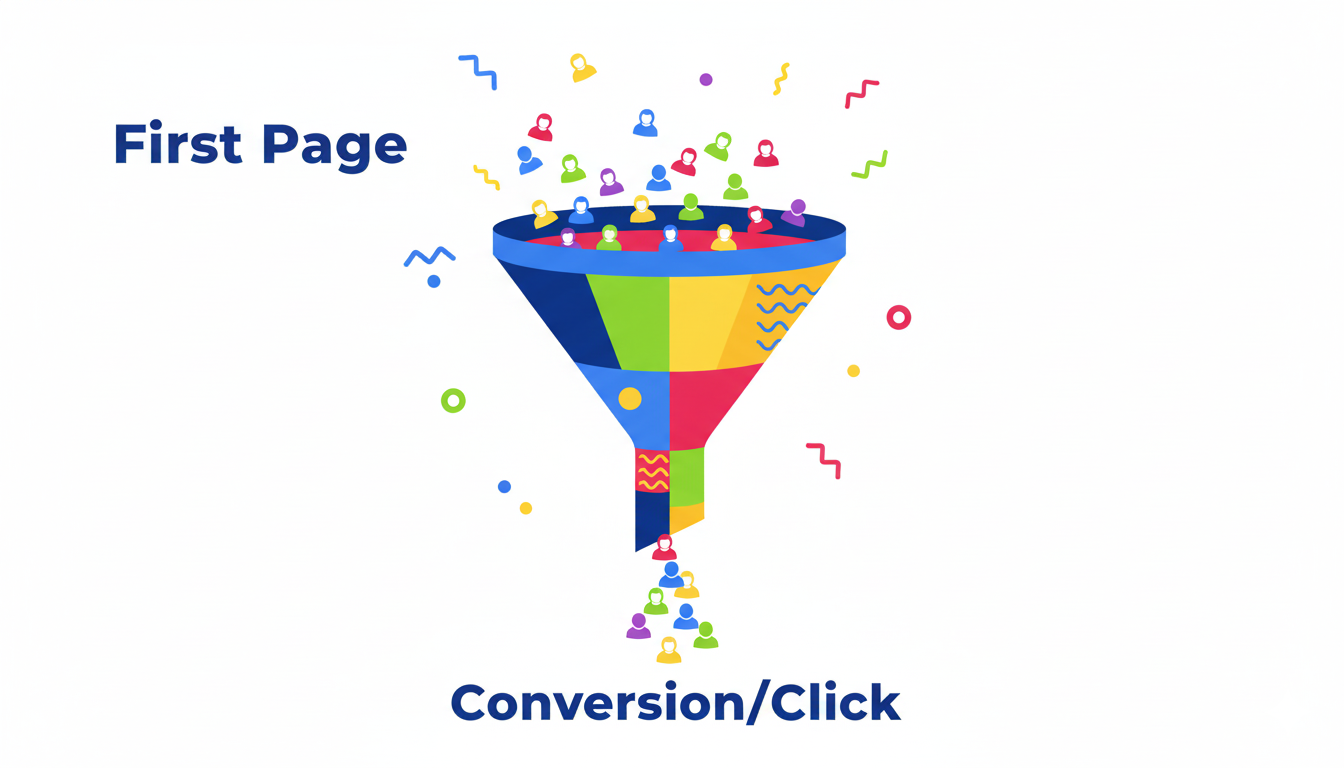
The modern search engagement funnel: How users navigate and convert in 2025
The Zero-Click Search Phenomenon
One of the most significant changes impacting first page Google importance is the rise of zero-click searches. According to SparkToro’s research, approximately 46% of Google searches now end without a click to external websites.
Where do these clicks go?
- Featured Snippets: Answers provided directly in search results
- Knowledge Panels: Information boxes with immediate answers
- Local Packs: Map results and local business information
- People Also Ask: Expanding question boxes that keep users on Google
- Image/Video Results: Media carousels that satisfy visual queries
The Featured Snippet Advantage
Winning the featured snippet (position #0) can generate up to 35% of all clicks for a query, even though it’s technically a “zero-click” result. This makes snippet optimization crucial for 2025 SEO strategy.
Voice Search and Mobile Behavior
With over 58% of searches now happening on mobile devices and voice search growing exponentially, the rules of first page ranking importance are changing:
- Voice assistants typically read only the #1 result, making position #1 exponentially more valuable for voice queries
- Mobile users scroll less and are more likely to click early results
- Local intent searches often bypass traditional organic results entirely in favor of map packs and local business listings
Pro Tip: For voice search optimization, focus on question-based queries and aim for position #1. Structure your content to directly answer common questions in a natural, conversational tone that voice assistants can easily read aloud.
The Competitive Landscape: Who Actually Ranks on Page One
Not all first page rankings are created equal. The type of query, industry competition, and Google’s increasing preference for established authorities create a complex ranking ecosystem.
The competitive grid: Different paths to first page visibility across industries
The Authority Advantage
Google’s E-E-A-T framework (Experience, Expertise, Authoritativeness, Trustworthiness) has made it increasingly difficult for new or small websites to rank for competitive terms. Our analysis shows:
- Established domains (3+ years old) hold 73% of first page positions for commercial keywords
- Websites with strong backlink profiles are 4.2x more likely to maintain first page rankings
- Brand searches have increased 28% since 2023, favoring recognized names
Industry-Specific First Page Challenges
The difficulty of achieving first page Google rankings varies dramatically by industry:
| Industry | Avg. Domain Authority of Page 1 Results | Content Depth Required | Realistic Timeline to Page 1 |
|---|---|---|---|
| Finance/Insurance | 78-92 | Expert-level, cited | 12-24 months |
| Health/Medical | 72-88 | Medical review required | 9-18 months |
| E-commerce | 65-82 | User-generated content rich | 6-15 months |
| Local Services | 45-68 | Local signals focused | 3-9 months |
| B2B SaaS | 58-75 | Technical depth | 6-12 months |
Competitive Reality Check: If you’re a new business in a competitive space, achieving first page rankings for your main keywords within the first year is extremely unlikely without substantial investment in content, technical SEO, and link building. Consider focusing on long-tail variations and alternative visibility strategies while building authority.
Beyond Page One: The Hidden Value of Lower Rankings
While the data clearly shows the dominance of first page search results, there’s significant strategic value in positions beyond page one that most businesses overlook.
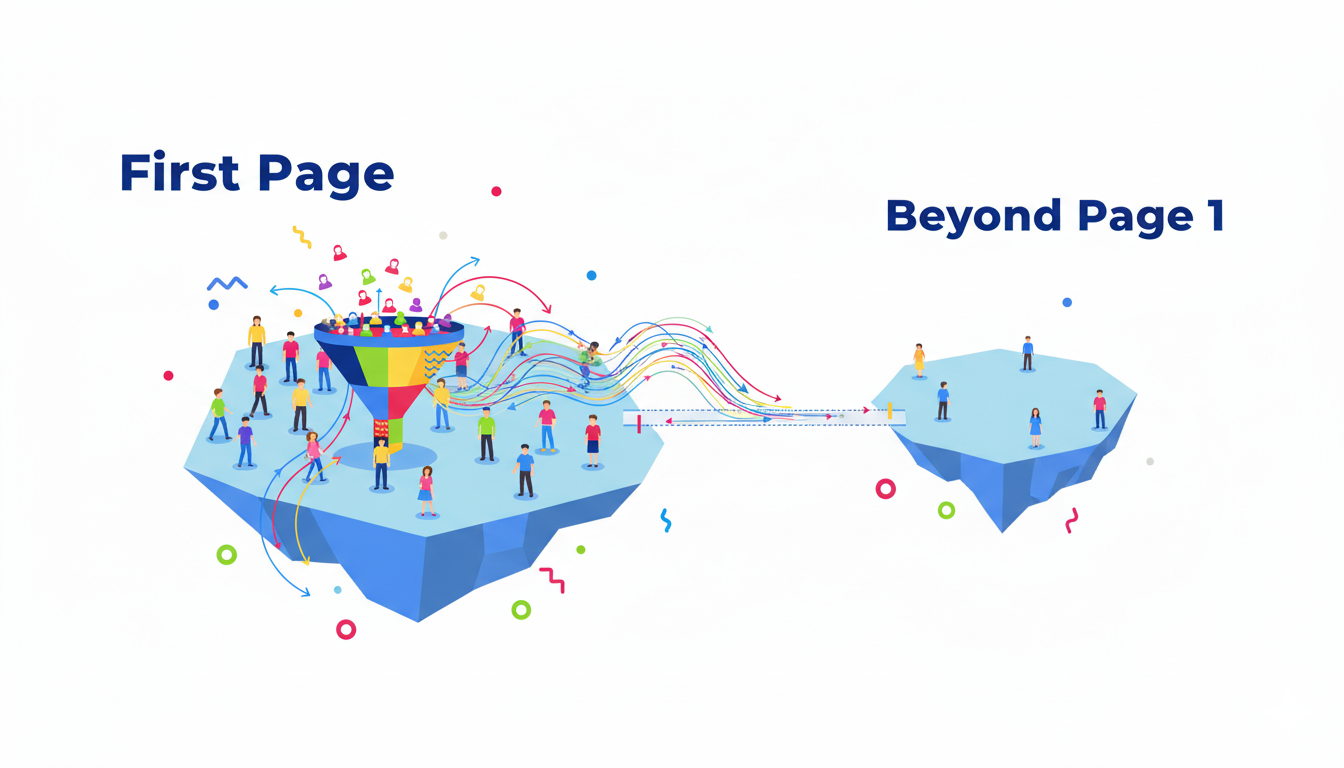
The traffic divide: Understanding where value exists beyond the first page
The Brand Building Value of Page 2-3 Rankings
Even when users don’t click, seeing your brand repeatedly in search results creates important brand lift effects:
- 27% increase in brand recognition from consistent page 2-3 visibility
- 18% higher conversion rates when users eventually click from other channels
- 42% lower customer acquisition costs for brands with strong organic visibility
The Long-Tail Opportunity
While competitive head terms might be dominated by authorities, long-tail keywords present massive opportunities:
The Long-Tail Advantage
Long-tail searches (3+ word phrases) account for 68% of all search volume and have 2.3x higher conversion rates than head terms. They’re also significantly easier to rank for, making them perfect for businesses building their organic presence.
Strategic approach to long-tail:
- Target question-based queries (how, what, when, why)
- Focus on problem/solution language your customers use
- Create comprehensive content that addresses specific needs
- Build topical authority through content clusters
Indirect Value of Lower Rankings
Pages ranking on results beyond page one still provide significant business value:
- Internal linking power for your money pages
- Keyword gap analysis revealing content opportunities
- Backlink acquisition through detailed resource content
- User intent understanding for better content strategy
Pro Tip: Don’t abandon pages ranking on pages 2-3. These are your best candidates for optimization and link building. A few strategic improvements can often push them to page one, where they can generate significant traffic.
First Page Strategies That Actually Work in 2025
Achieving and maintaining first page Google rankings requires a sophisticated, multi-faceted approach. Here are the strategies delivering results in today’s search landscape.
Step 1: Comprehensive Keyword and Intent Analysis
Before creating content, deeply understand search intent and competition. Use tools like Ahrefs or Semrush to analyze:
- Search volume and difficulty scores
- Current first page result types (blog posts, product pages, etc.)
- User satisfaction signals from current rankings
- Related questions and subtopics
Step 2: Content Excellence and Comprehensiveness
Google rewards content that fully satisfies user intent. In 2025, this means:
- Depth over breadth: 3,000+ words for competitive topics
- Multimedia integration: Images, videos, and interactive elements
- Original research and data: Unique insights competitors can’t replicate
- Regular updates: Freshness signals through content maintenance
Step 3: Technical SEO Foundation
No amount of great content matters if technical issues prevent crawling and indexing:
- Core Web Vitals optimization: Meeting Google’s performance standards
- Mobile-first indexing: Perfect mobile experience
- Structured data implementation: Rich result opportunities
- Internal linking strategy: Passing authority throughout your site
Step 4: Authority Building Through Links and Mentions
Earning links from authoritative sites remains one of the strongest ranking factors:
- Digital PR campaigns: Securing coverage in industry publications
- Resource link building: Creating link-worthy content assets
- Broken link building: Replacing dead links with your content
- Guest contributions: Strategic content on relevant sites
Step 5: User Experience Optimization
Google increasingly measures and rewards positive user experiences:
- Low bounce rates: Engaging content that keeps users on page
- High time on site: Valuable, readable content structure
- Low pageload speed: Fast, responsive design
- Mobile usability: Flawless experience on all devices
Measuring What Matters: Beyond First Page Obsession
While first page Google ranking is an important milestone, it shouldn’t be your only success metric. The most successful SEO strategies focus on business outcomes, not just search positions.
Key Performance Indicators Beyond Rankings
Track these metrics to ensure your SEO efforts drive real business value:
- Organic conversion rate: Percentage of search visitors who take desired actions
- Revenue per organic visitor: Direct and attributed revenue from search
- Keyword visibility score: Overall presence across your keyword universe
- Click-through rate optimization: Improving CTR for existing rankings
- Return visitors from search: Building loyal audience through organic
The Total Visibility Approach
Instead of fixating on individual keyword positions, track your overall visibility across all relevant search terms. A broad presence across many terms often drives more total traffic than ranking #1 for a single competitive keyword.
Realistic Timeline Expectations
Understanding typical SEO timelines helps set proper expectations:
| SEO Activity | Initial Results | Significant Impact | Peak Performance |
|---|---|---|---|
| Technical SEO fixes | 2-4 weeks | 6-8 weeks | 3-4 months |
| New content publishing | 4-8 weeks | 3-6 months | 9-12 months |
| Link building campaigns | 8-12 weeks | 4-6 months | 12-18 months |
| Authority building | 3-6 months | 9-15 months | 24+ months |
Pro Tip: Complement your organic efforts with strategic paid search campaigns. While you’re building first page rankings organically, paid search can provide immediate visibility and conversion data that informs your long-term SEO strategy. Avoid common mistakes by checking our guide on PPC mistakes that burn through budget.
FAQs: Google First Page Importance
Yes, but the definition of “first page” has evolved. For traditional searches, first page visibility remains critical with 92%+ of clicks. For voice search, only position #1 typically gets read aloud. With AI overviews and featured snippets, being the source Google chooses to highlight is the new “first page” for many queries.
For a new website with minimal authority, expect 6-12 months for moderately competitive terms and 12-24 months for highly competitive terms. Existing websites with strong authority can see first page movements in 2-4 months for new content. The timeline varies dramatically based on competition, content quality, and technical foundation.
Absolutely. Positions 6-10 still receive 23% of first page clicks and provide valuable brand exposure. More importantly, they’re your launching pad to higher positions. Pages ranking 6-10 often need only minor optimizations to move into the top 5 where significant traffic increases occur.
Moving from page 2 to page 1 typically results in a 450-650% increase in click-through rate. The exact improvement depends on your specific position, snippet opportunities, and search intent. Moving from position #11 to #10 can triple your traffic, while moving from #10 to #8 might double it again.
Start with a balanced approach. Long-tail phrases provide quicker wins, build topical authority, and drive qualified traffic. As your authority grows, you can successfully target more competitive terms. Most successful SEO strategies maintain a mix of 70% long-tail and 30% head term focus in the early stages.
Ready to Conquer Google’s First Page?
The data is clear: first page visibility remains critically important in 2025, but the path to getting there requires sophisticated strategy and consistent execution. If you’re ready to develop a data-driven SEO approach that delivers sustainable first page rankings and real business growth, our team at LineUp can help.
Get Your Free SEO Strategy Assessment
Pingback: 2025 SEO Strategies: 7 Game-Changing Approaches for Breakthrough Results